
Marketplace price monitoring
Monitor prices, promotions and price changes across marketplaces
Do you always have insight into your competitors’ current prices on marketplaces?
Marketplaces are among today’s most dynamic pricing environments.
Every day, thousands of sellers change their prices, launch new promotions or adjust discounts. Prices of popular products may even change several times a day.
For brands, retailers, manufacturers and e-commerce organisations, this makes it virtually impossible to keep track of prices manually.
At the same time, these price changes directly affect products’ price position, margins and commercial performance within marketplaces.
Scrape IT automates marketplace price monitoring by continuously collecting, validating and historically storing pricing information from public marketplaces. This gives your organisation constant access to both current and historical price information, allowing you to base pricing decisions on facts instead of assumptions.
Why marketplace price monitoring is becoming increasingly important
A marketplace price tells you much more than what a product costs today.
Price changes reveal how sellers adjust their pricing strategies. Examples include temporary promotions, structural price reductions, discount campaigns and price adjustments around holidays or commercial campaigns.
Looking only at the current price gives you nothing more than a snapshot.
Tracking price developments over a longer period helps answer questions such as:
- Which competitor is structurally lowering its prices?
- Which products are regularly discounted?
- When do promotional campaigns start?
- Which sellers respond immediately to competitors’ price changes?
- Which products are deliberately offered below the market price?
- Which price changes actually require action?
These insights help pricing teams make better commercial decisions.
Expert insight
A price reduction does not automatically require a response.
The question is not only which price is changing, but above all which price changes actually affect your pricing strategy.
Combining current prices with historical price developments reveals whether a price change is part of a temporary promotion, an automated pricing strategy or a structural adjustment to the market price.
Common marketplace pricing challenges
Competitor prices change faster than manual checks can keep up
Many organisations still check competitors’ prices manually.
This remains manageable when only a few products and sellers are involved. Once hundreds or thousands of products need to be tracked, however, manual checks become practically impossible.
As a result, price changes are often only discovered after they have already affected revenue, margins or price position.
Historical price developments are missing
A current price tells only part of the story.
Sound pricing decisions require insight into how prices develop over longer periods. This includes:
- historical price developments
- promotional patterns
- price-change frequency
- lowest selling price
- highest selling price
- average selling price
- recurring discount campaigns
Without historical data, it remains difficult to assess competitors’ pricing strategies accurately.
Promotions go unnoticed
Marketplaces feature thousands of temporary offers every day, including:
- discount campaigns
- coupons
- cashback offers
- bundle discounts
- temporary deals
- seasonal promotions
When these are not monitored automatically, an important part of competitors’ pricing behaviour remains invisible.
Price comparisons are not always reliable
Comparable products may be displayed differently across marketplaces. If product records are not linked correctly, price comparisons can be incomplete or misleading.
Reliable product matching is therefore an essential part of dependable marketplace price monitoring.
Pricing teams respond too late
Without current pricing information, organisations often respond only after a price change has already had an impact.
Continuous marketplace price monitoring helps identify relevant price changes sooner, detect anomalies automatically and support better pricing decisions.
Continuous marketplace price monitoring at scale
Effective marketplace price monitoring involves more than collecting individual prices.
Pricing information must be:
- validated
- linked to the correct product information
- compared with other sellers
- stored historically
- checked for anomalies
- made available in existing systems
Scrape IT collects pricing information from public marketplaces and converts it into reliable datasets, dashboards, alerts and API integrations.
Depending on the marketplace and use case, price updates can be processed daily or several times a day.
Marketplace price monitoring can be used for:
- price comparisons
- price optimisation
- promotion monitoring
- historical price analysis
- price alerts
- margin control
- pricing dashboards
- automated pricing processes
- AI and analytics applications
What do we monitor?
Current prices
We collect information including:
- current selling prices
- recommended retail prices
- promotional prices
- prices per seller
- prices per marketplace
- prices per product variant
- price differences between sellers
This provides immediate insight into products’ current price position within marketplaces.
Price changes
Price changes are detected automatically.
We identify:
- price increases
- price decreases
- sudden price anomalies
- the start of promotions
- the end of promotions
- discount campaigns
- cashback campaigns
- changes to recommended retail prices
This immediately reveals when sellers adjust their pricing strategy.
Historical price developments
A current price says little without context.
We therefore store historical pricing data to show:
- how prices develop over time
- the lowest and highest recorded prices
- how often a price changes
- how long promotions last
- which discount campaigns recur
- which sellers are consistently cheaper
- how the average market price develops
This makes pricing strategies and patterns easier to identify.
Promotions and discount campaigns
Promotions are an important part of marketplace price monitoring.
We monitor:
- temporary offers
- discount percentages
- coupons
- bundle discounts
- cashback offers
- seasonal promotions
- price reductions around campaigns
This reveals when competitors launch promotions, how long they last and how often they recur.
Prices per seller
Within a single marketplace, the same product may be offered by several sellers.
We can therefore break down pricing information by seller. This provides insight into:
- price differences between sellers
- consistently low-priced sellers
- rapid price responses
- changes in the number of offers
- development of the lowest selling price
This shows not only what a product costs, but also how individual sellers position themselves on price.
Buy Box and price position
Price is often one of the factors that influences the Buy Box and other prominent sales positions within marketplaces.
Combining pricing information with changes in the Buy Box can provide insight into:
- which seller wins the Buy Box
- the price offered at that time
- how Buy Box positions change after price adjustments
- which sellers consistently maintain a strong price position
This enables closer analysis of the relationship between pricing and commercial visibility.
Availability as pricing context
Availability is not a primary pricing metric, but it can help explain price changes.
A price increase may, for example, be related to:
- limited inventory
- a declining number of active sellers
- temporary unavailability
- a product that is almost sold out
Availability information can therefore be included as additional context in pricing analyses.
Automated price alerts
Receive an automatic notification when:
- a price changes
- a competitor undercuts your price
- a price moves above or below a set threshold
- a promotion starts
- a promotion ends
- a selected product suddenly drops sharply in price
- a price falls outside set margins
- a Buy Box position changes alongside a price change
This means your team no longer needs to check marketplaces continuously by hand.
Practical example: from individual prices to a reliable pricing dashboard
Marketplace pricing information only delivers real value when it is readily available to the people and systems that use it.
Scrape IT makes the collected pricing data available through dashboards, reports, API integrations and other connections, ensuring organisations always have access to current pricing information.
Users can:
- compare current prices
- analyse historical price developments
- track promotions
- visualise price differences between sellers
- manage price alerts
- add products to watchlists
- export reports
This gives pricing teams continuous access to the insights they need to assess price developments faster and make better-informed pricing decisions.
Make price developments immediately visible
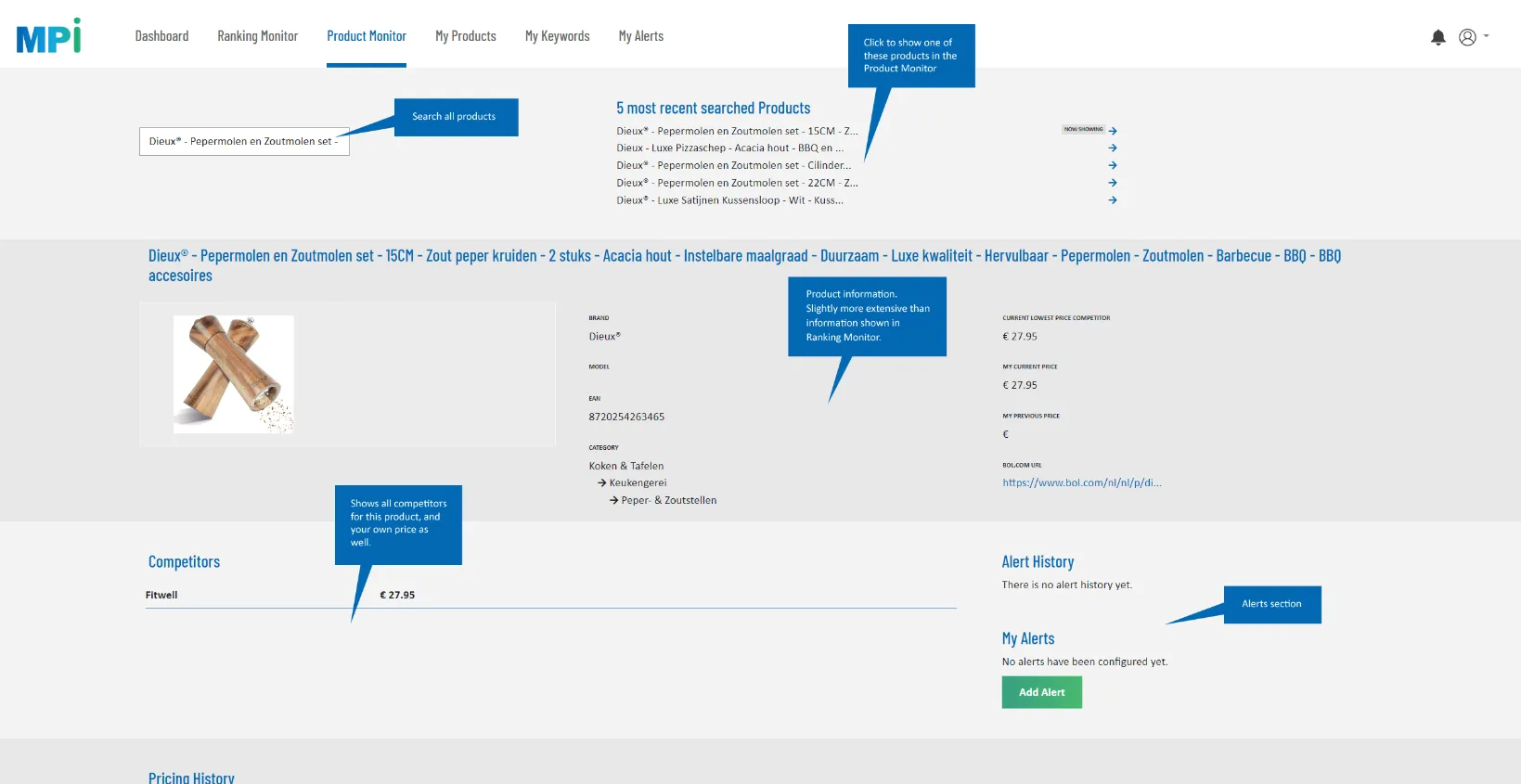
The collected pricing information is automatically made available in interactive dashboards, allowing pricing teams to analyse current prices, historical price developments and promotions with ease.
Users can:
- compare current prices
- analyse historical price trends
- track price differences between sellers
- monitor promotions
- manage price alerts
- add products to watchlists
- export reports
Gain real-time insight into current prices, historical price developments, promotions, price differences between sellers and automated price alerts. Analyse price developments, compare products and support pricing decisions with current marketplace data.
From price checks to pricing strategy
Many organisations still compare marketplace prices manually. This provides only a snapshot.
Automatically collecting and historically storing prices reveals:
- when prices rise or fall
- how long promotions last
- which products are regularly discounted
- which sellers are consistently cheaper
- how competitors respond to price changes
- which price changes are temporary or structural
The question therefore changes from:
What does this product cost today?
to:
Which pricing strategy is my competitor using, and when should I respond?
This distinction is precisely what makes marketplace price monitoring a strategic tool for pricing teams.
What does marketplace price monitoring deliver?
Automatically collecting and continuously updating pricing information creates a more reliable foundation for pricing decisions.
Organisations use marketplace price monitoring for:
- price optimisation
- margin improvement
- promotion analysis
- price comparisons
- tracking competitor prices
- price alerts
- pricing dashboards
- commercial reporting
- support for dynamic pricing
As a result, many organisations achieve:
- less manual work
- faster insight into price changes
- better-informed pricing decisions
- better margin protection
- greater control over promotions
- a more current view of their price position
- faster responses to relevant price changes
Which organisations benefit from marketplace price monitoring?
Retailers
Compare marketplace prices and support pricing decisions.
Brands and manufacturers
Understand how products are offered and priced by different sellers.
Distributors and wholesalers
Track price differences, price developments and promotions across distribution channels.
Marketplace sellers
Monitor your own price position in relation to other sellers.
Pricing teams
Conduct historical analyses, manage price alerts and develop a better-informed pricing strategy.
Category managers
Gain insight into price developments across product groups and categories.
Combine marketplace price monitoring with other solutions
Marketplace competitor analysis
For organisations that want insight into new sellers, assortments, product launches, category developments and broader market changes in addition to price developments.
Data matching
Link identical and comparable products from different sellers, even when titles, article numbers or product attributes differ.
Dashboarding
Visualise current and historical price developments in clear dashboards and reports.
MCP AI data integration
Make current marketplace prices directly available to AI assistants, analyses and automated business processes.
From pricing information to pricing intelligence
Almost any organisation can collect current prices.
The difference lies with organisations that understand why prices change and which price developments genuinely require action.
Combining current prices with historical price developments, promotional patterns, product matching, price alerts and additional context creates Pricing Intelligence.
This turns marketplace price monitoring into more than a collection of individual prices. It becomes a strategic information source that helps organisations respond faster to relevant price changes, protect margins and make better-informed pricing decisions.
Frequently asked questions
What is marketplace price monitoring?
Marketplace price monitoring is the automated collection and tracking of prices on online marketplaces. It gives organisations insight into current prices, price changes, promotions, price differences between sellers and historical price developments.
Why is marketplace price monitoring important?
Marketplace prices change constantly. Competitors launch promotions, adjust prices or respond to other sellers. Without automated price monitoring, these changes are often only discovered after they have already affected revenue, margins or price position.
What pricing information can Scrape IT monitor?
Depending on the marketplace, we can collect current selling prices, recommended retail prices, promotional prices, prices per seller, discount percentages, cashback offers, historical price developments, price alerts and availability information as additional context.
How often are marketplace prices updated?
This depends on the marketplace, the number of products and your information needs. For many applications, prices can be collected daily or several times a day, providing your organisation with up-to-date price information for pricing, dashboards and reporting.
Can historical price data be stored?
Yes. We can store historical price developments so you can analyse price increases and decreases, lowest and highest prices, average selling prices, promotional patterns, price-change frequency and sellers' pricing strategies.
Can prices be tracked per seller?
Yes. When several sellers offer the same product, their prices can be collected separately. This reveals which sellers are consistently cheaper and how their price position develops.
Can Scrape IT distinguish promotional prices from regular prices?
This depends on the information shown by the marketplace. When regular prices, promotional prices, discount percentages or coupons are visible, they can be collected separately and stored historically.
Can I receive automatic notifications about price changes?
Yes. Scrape IT can send alerts when, for example, a competitor lowers its price, a price falls below a set threshold, a promotion starts or ends, a price changes significantly or a selected product changes price. Depending on the solution, alerts can be delivered by email, dashboard, API or other integrations.
Can price alerts be based on margins or thresholds?
Yes. Price alerts can be configured using predefined conditions, such as a minimum price difference, maximum price decrease, set market price, minimum margin or a competing seller undercutting your price. The exact configuration is aligned with your pricing process.
Can I analyse the relationship between price and the Buy Box?
When the required information is available, price developments can be combined with Buy Box positions. This makes it possible to investigate how price changes relate to winning or losing the Buy Box.
Can comparable products be matched automatically?
Yes. Data Matching can link products using EAN codes, article numbers, titles, specifications and product attributes. This also makes it possible to compare products that are not described identically everywhere.
Which marketplaces can be monitored?
Scrape IT can monitor national and international marketplaces. Which platforms can be monitored from a technical and practical perspective depends on the marketplace, required information, update frequency and assortment size.
Is marketplace price monitoring suitable for large assortments?
Yes. The solution can be configured for hundreds, thousands or very large numbers of products. Price information is collected and validated automatically, then made available through dashboards, exports or API integrations.
How is the data delivered?
Marketplace price data can be delivered through APIs, dashboards, CSV, Excel, JSON, XML, Parquet, Power BI, MCP, EDI, (S)FTP, email alerts or a direct integration with your own systems. Almost any required delivery or integration method is possible.
Can marketplace price monitoring be combined with competitor analysis?
Yes. Many organisations combine marketplace price monitoring with marketplace competitor analysis. This provides insight into current prices, price changes, promotions and alerts, as well as new sellers, assortments, product launches, category developments and market position.