
Marketplace competitor analysis
Monitor sellers, assortments & competitors
Do you know what is really changing in your market today?
Marketplaces are among the most current sources of market information.
New products appear every day, sellers expand their assortments, new brands enter the market and product categories shift. At the same time, products disappear, sales strategies change and new players quickly gain visibility.
For retailers, brands, manufacturers, distributors and e-commerce organisations, it is therefore increasingly important not only to track known competitors, but to maintain a continuous view of the entire marketplace landscape.
Scrape IT automates marketplace competitor analysis by systematically collecting, validating and historically storing public marketplace data. This creates a single, current view of the market, enabling your organisation to identify changes sooner and make better-informed commercial and strategic decisions.
Why marketplace competitor analysis is becoming increasingly important
Marketplaces are much more than sales channels.
Almost every day, they reveal how markets, product categories and competitive landscapes are developing.
New brands are introduced. Competitors add products. International sellers enter the market. Product categories grow or change. Existing products disappear from assortments.
Organisations that track these developments systematically often see before others:
- which new sellers become active
- which brands expand their presence
- how competitors’ assortments change
- which product categories are growing
- which product variants are gaining popularity
- which sellers are gaining or losing ground
- where new commercial opportunities emerge
Marketplace competitor analysis therefore helps organisations not only track known competitors, but above all identify broader market developments at an early stage.
Expert insight
The most important market changes rarely begin with a press release.
They often become visible earlier when new products appear, competitors expand their assortments, new brands become active or international sellers join a marketplace.
Tracking these signals historically provides earlier insight into structural market developments that may not appear in traditional market reports until months later.
Common challenges in marketplace competitor analysis
New competitors remain out of sight
Many organisations mainly track competitors they already know.
As a result, new sellers, international vendors and fast-growing brands often remain unnoticed until they have already established a clear market position.
Continuous marketplace monitoring reveals when new parties become active and how their presence subsequently develops.
Assortment developments are difficult to track
Assortments change constantly.
Competitors add new products, remove existing ones, introduce new variants and expand into other product categories.
Manual checks may still be possible when only a few competitors and products are being tracked. With hundreds or thousands of products, this becomes practically impossible.
As a result, organisations often lack a complete and current view of competitors’ assortment strategies.
Market information is spread across different sources
Relevant information is distributed across:
- different marketplaces
- seller pages
- product categories
- brands
- suppliers
- search results
- individual product pages
This makes it difficult to analyse changes in context.
Scrape IT brings this information together in one structured dataset, allowing developments across different sellers, products and platforms to be compared.
Manual analyses provide only a snapshot
A manual marketplace analysis usually shows only what the market looks like at that particular moment.
It does not reveal:
- when a product was added
- how long a seller has been active
- how quickly an assortment is growing
- which products disappear structurally
- how brand visibility changes
- how categories develop over longer periods
Storing marketplace data historically creates a continuous view of market changes.
Traditional market research quickly becomes outdated
Traditional market reports are often published periodically and based on information from an earlier period.
Marketplaces, by contrast, change every day.
Continuous marketplace competitor analysis therefore provides a more current view of products, sellers, assortments and market visibility.
Continuous marketplace competitor analysis at scale
Effective marketplace competitor analysis involves more than collecting individual product pages.
The data must be:
- structured
- validated
- deduplicated
- linked to the correct brands and sellers
- stored historically
- checked for changes
- made available for analysis
Scrape IT collects public marketplace data and transforms it into reliable datasets, dashboards, alerts and API integrations.
Depending on the marketplace and information requirements, data can be updated daily, weekly or at another required frequency.
Marketplace competitor analysis can be used for:
- competitor analysis
- assortment analysis
- market monitoring
- category management
- product development
- innovation
- expansion research
- market positioning
- trend analysis
- strategic decision-making
What do we monitor?
Active and new sellers
We identify:
- active sellers
- new sellers
- sellers that have disappeared
- international sellers
- sellers by product category
- sellers expanding into new categories
- developments in the number of active offers
This provides a current view of the competitive landscape and reveals which parties are expanding their presence.
Inventory and sales activity
Changes in available inventory can also provide valuable information about competitor activity and product demand.
Monitoring marketplace inventory levels daily or weekly creates a historical view of inventory movements. It reveals, for example, when new inventory is added and how quickly the available stock subsequently decreases.
We can monitor:
- current inventory levels
- inventory movements by product
- when inventory is replenished
- frequency of inventory updates
- the rate at which inventory decreases
- temporary stock shortages
- products becoming available again
- inventory developments over time
Systematic monitoring can reveal patterns that remain hidden in a one-off check.
For example, if new inventory is added every Tuesday and gradually decreases throughout the week, this provides insight into a product’s replenishment cycle and potential sales activity.
Depending on how a marketplace displays inventory data, inventory movements can also be used to estimate the number of products sold. Combined with other available data, this can help analyse sales volume and revenue potential.
Inventory monitoring therefore reveals not only what competitors offer, but also how actively products are sold on a marketplace and how demand and availability develop over time.
Product assortments
We monitor how the assortments of brands and sellers change.
This can include:
- new products
- removed products
- assortment expansions
- product variants
- brands
- product lines
- product categories
- changes to product specifications
- changes in the number of products offered
This reveals how competitors develop their assortments and which product groups they invest in.
New product launches
New products can provide important signals about innovation, positioning and future market developments.
We can identify:
- new product launches
- new brands
- new product variants
- expansions of existing product lines
- new categories
- launches within specific countries or marketplaces
Tracking product launches historically reveals which organisations innovate first and which trends are subsequently adopted by the wider market.
Availability and supply developments
Changes in availability can provide valuable signals about the development of supply within a marketplace.
We monitor:
- products that become newly available
- products that are temporarily unavailable
- products that disappear structurally
- products that become available again
- changes in the number of active offers
- changes in the number of sellers per product
Tracking this data historically provides insight into changes in assortments, supply and product categories.
Availability is used here as a market signal. By itself, it is not conclusive evidence of actual sales volumes or market demand.
Market position and visibility
The visibility of brands and sellers within marketplaces changes constantly.
We can analyse:
- presence within important product categories
- category positions
- positions within search results
- visibility of brands and sellers
- changes in the number of visible products
- growth or decline of presence within categories
- shifts between different sellers
This reveals which brands and sellers are expanding their marketplace presence and which parties are losing ground.
Product-category developments
Marketplace data can also be used to track changes at category level, including:
- growth in the number of products
- entry of new brands
- expansion of product variants
- changes in product specifications
- developments in the number of sellers
- emergence of new subcategories
- products that disappear from the market structurally
This gives your organisation a broader view of how product categories are developing.
Brands and product variants
Dozens of brands and variants can be active within a single product group.
We can provide insight into:
- which brands are active
- which new brands appear
- which brands expand their assortments
- which product variants are added
- which specifications become more common
- which product lines disappear
- how supply develops by brand
This provides a clearer view of product positioning and innovation within the market.
Automatic market alerts
Receive an automatic notification when, for example:
- a new seller becomes active
- a competitor adds a new product
- a brand introduces a new product line
- a product disappears structurally
- a competitor expands into a new category
- the number of active offers changes significantly
- a seller rapidly gains visibility
- a relevant change occurs within a selected product group
This eliminates the need for your team to check marketplaces continuously by hand.
From individual marketplace data points to a current market dashboard
Marketplace data delivers real value when changes can be analysed clearly and in context.
Scrape IT can make the collected data available in a dashboard where users can:
- compare sellers and brands
- track assortment developments
- identify new products and brands
- analyse changes by product category
- review historical developments
- track competitor visibility
- create watchlists
- manage market alerts
- filter data by country, brand, seller or category
- export reports
This creates one central environment in which commercial and strategy teams can determine more quickly which market developments require attention.
Marketplace competitor analysis dashboard
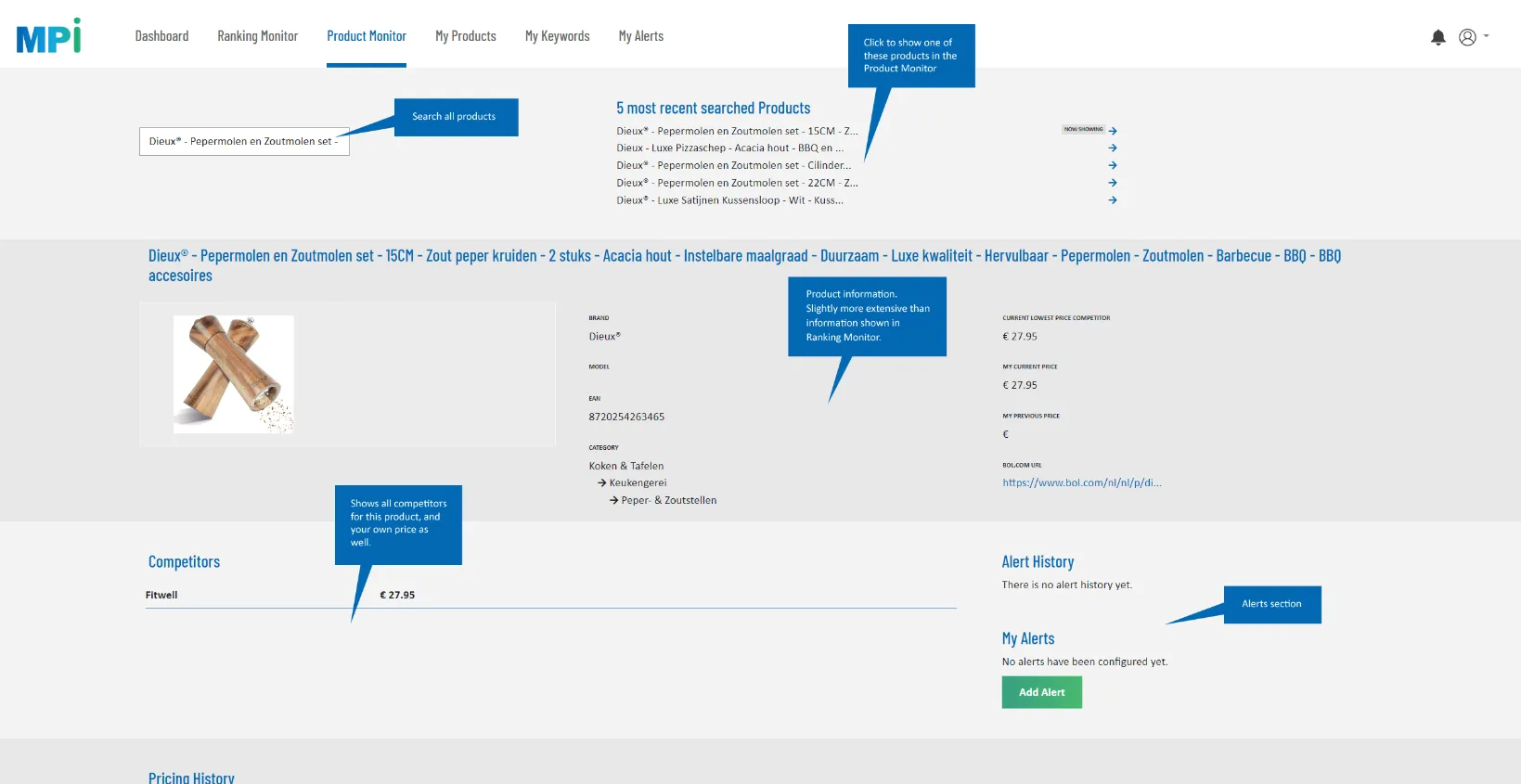
Gain real-time insight into sellers, brands, assortments, product launches and market developments on marketplaces. Compare competitors, analyse assortment changes and receive automatic notifications when relevant market developments occur.
Practical example: from known competitors to a complete market view
Many organisations track only a limited number of known competitors.
This creates an incomplete view of the market.
New brands, international sellers and fast-growing providers may remain out of sight. It is also often unclear how assortments are developing or which product categories are changing.
Automatically collecting and historically storing marketplace data reveals:
- which new sellers become active
- which competitors expand their assortments
- which brands introduce new product lines
- which products and variants are added
- which categories are developing
- which sellers are building greater visibility
- which products or brands disappear structurally
The question therefore changes from:
What is my largest competitor doing?
to:
Which developments are changing my market, and which parties are gaining ground?
This is what makes marketplace competitor analysis a strategic tool for category managers, product teams, marketing teams and management boards.
What does marketplace competitor analysis deliver?
Continuously collecting and historically analysing marketplace data creates a more reliable foundation for market and competitive decisions.
Organisations use marketplace competitor analysis for:
- competitor analysis
- assortment analysis
- category management
- market monitoring
- product development
- innovation research
- strategic planning
- expansion research
- positioning decisions
- commercial reporting
As a result, many organisations achieve:
- earlier insight into new market developments
- a better overview of competitors
- faster detection of new sellers
- less manual research
- current insight into assortment changes
- better-informed product decisions
- faster identification of commercial opportunities
- a more complete view of the competitive landscape
Which organisations benefit from marketplace competitor analysis?
Retailers
For insight into new sellers, brands, assortments and developments within relevant product categories.
Brands and manufacturers
For tracking their own market position and competitors’ introduction of new products and product variants.
Distributors and wholesalers
For insight into changes in assortments, sellers and product categories.
E-commerce organisations
For tracking new players, market developments and changes in online supply.
Category managers
For a current overview of brands, products, sellers and developments within specific categories.
Product managers
For insight into competitors’ product launches, product attributes, variants and innovations.
Marketing and strategy teams
For identifying market developments and supporting positioning and growth decisions.
Market researchers
For access to current and historical marketplace data as a complement to traditional market research.
Combine marketplace competitor analysis with other solutions
Marketplace price monitoring
For organisations that want insight into current prices, price changes, promotions and sellers’ pricing strategies alongside market developments.
Data Matching
Link identical and comparable products from different marketplaces, brands and sellers, even when titles, article numbers or attributes differ.
Dashboarding
Visualise competitors, assortments, category developments and market changes in clear dashboards and reports.
MCP AI Data Integration
Make current marketplace data directly accessible to AI assistants, analytics and automated business processes.
From marketplace data to market intelligence
Marketplace data consists of thousands of individual signals.
A new product. A new seller. An assortment expansion. A brand becoming visible in multiple categories. A product line gradually disappearing from the market.
Individually, these changes tell only part of the story.
Combining data about sellers, brands, assortments, product launches, availability, categories and visibility creates Market Intelligence.
This makes marketplace competitor analysis more than an overview of products and sellers.
It becomes a strategic source of information that enables organisations to identify market changes sooner, understand competitors better and make better-informed commercial and strategic decisions.
Frequently asked questions
What is marketplace competitor analysis?
Marketplace competitor analysis is the automated collection and analysis of data about sellers, brands, assortments, products, product categories and visibility on online marketplaces. It provides a current and historical view of the competitive landscape and how the market is developing.
Why is marketplace competitor analysis important?
Marketplaces change every day. New sellers become active, competitors expand their assortments and new brands and products are introduced. Without continuous monitoring, these changes are often only discovered after they have affected market position or commercial results. Marketplace competitor analysis helps organisations identify relevant developments sooner.
Which information can Scrape IT collect?
Depending on the marketplace, we can collect sellers, brands, product titles, product categories, specifications, product variants, availability, assortments, category positions, search-result positions, first- and last-seen dates and changes over time. The exact dataset is tailored to your information requirements.
Can Scrape IT automatically detect new sellers?
Yes. We can detect when new sellers or brands become active within a marketplace, product category or selected product group. These changes can be included in a dashboard, dataset or automatic alert.
Can assortment changes be tracked historically?
Yes. Collecting products and assortments periodically reveals when products are added or removed, which product lines are expanded, which new variants appear and how a competitor's assortment grows or shrinks.
Can I analyse market developments by product category?
Yes. Marketplace data can be grouped and analysed by category, subcategory, brand, seller, country or another relevant attribute. This reveals which categories are growing, where new brands are appearing and how the number of products and sellers is developing.
Can international sellers be tracked separately?
Yes. When country, seller or location data is available, national and international sellers can be analysed separately. This allows you to track which foreign parties enter a market and how their presence develops.
Can new products and brands be identified automatically?
Yes. By comparing current data with previous observations, new products, brands, product variants and categories can be detected automatically.
Can visibility within marketplaces be tracked?
Yes. Depending on the marketplace, category positions, search results and the presence of brands and sellers can be tracked. This shows which parties are becoming more or less visible within relevant parts of the marketplace.
Can availability be used to determine market demand?
Availability can be a valuable market signal, but does not by itself show how many products have actually been sold. Availability changes are therefore primarily used to analyse developments in supply, assortments and the number of active sellers. For reliable conclusions, availability data should preferably be combined with other information.
How are comparable products and product variants grouped?
Data Matching can link products using EAN codes, article numbers, product titles, brands, technical specifications, dimensions, colours, storage capacity and other product attributes. This makes it possible to compare products even when they are described differently across marketplaces.
Which marketplaces can be monitored?
Scrape IT can monitor national and international marketplaces. Which marketplaces and data are technically available depends on the platform, required information, update frequency and scope of the project.
Is marketplace competitor analysis suitable for large numbers of products?
Yes. The solution can be configured for hundreds, thousands or very large numbers of products and sellers. Data is collected automatically, validated, stored historically and made available through dashboards, exports or API integrations.
How is the data delivered?
Marketplace data can be delivered through APIs, dashboards, CSV, Excel, JSON, XML, Parquet, Power BI, MCP, EDI, (S)FTP, email alerts or a direct integration with your own systems. Virtually any required form of data delivery or integration is possible.
What is the difference between marketplace competitor analysis and marketplace price monitoring?
Marketplace competitor analysis focuses on new sellers, brands, assortments, product launches, product categories, supply developments, market position, visibility and broader market developments. Marketplace price monitoring focuses on current prices, price changes, promotions, price differences, historical price developments, price alerts and pricing strategies. Many organisations combine both solutions.