
Real estate market intelligence
Monitor property supply, projects & market developments
Do you know what is happening in the real estate market today?
The real estate market changes every day.
New homes come onto the market. Property developers launch new construction projects. Business locations become available and entire areas develop rapidly.
At the same time, some of these developments take place outside the well-known property platforms. New-build homes, for example, are offered and sold directly through project websites, which means important market information is not always visible when only the major property platforms are considered.
For property developers, investors, real estate advisers, municipalities and commercial organisations, these developments are often more valuable than a traditional market report.
Those who identify changes early see opportunities sooner.
Scrape IT collects, structures and updates real estate information from public sources. Property and project data can also be combined with supplementary information from organisations such as Statistics Netherlands (CBS) and the Netherlands’ Cadastre, Land Registry and Mapping Agency (Kadaster).
This creates an increasingly complete and up-to-date digital view of the real estate market. By continuously updating and combining different data sources, it becomes possible to work towards a digital twin of the real estate market: a digital representation designed to reflect the real-world situation as accurately as possible.
This gives organisations access to current real estate market information on which to base investment, location and strategic decisions.
Why real estate information is becoming increasingly important
The real estate market encompasses much more than homes listed for sale.
Thousands of new signals emerge every day, showing how a market is developing. These include:
- new residential projects
- new business locations
- new-build developments
- rental properties and homes for sale
- logistics locations
- retail premises
- office developments
- area developments
Individually, these may appear to be isolated events.
Together, they reveal where investments are being made, which regions are growing and where new commercial opportunities are emerging.
Organisations that continuously monitor these developments have a far more current view of the real estate market than organisations that rely solely on periodic research.
Expert insight
Real estate data does not only show what is available today.
Its greatest value emerges when developments become visible over time.
Changes in supply, new construction, locations and area development provide early indications of where markets are growing and new opportunities are emerging.
Common challenges surrounding real estate information
Real estate information is fragmented
Relevant real estate information is spread across dozens of public sources, including:
- residential property platforms
- commercial real estate platforms
- property developers
- estate agents
- municipalities
- public registers
As a result, a single complete and current overview is often unavailable.
New projects are discovered too late
Many organisations only hear about a project once construction has already started.
This causes commercial opportunities to be missed.
Automatically identifying new projects provides earlier insight into future developments.
Location developments are difficult to track
Regions are constantly changing.
New business parks are created. Shopping districts grow. Logistics locations develop. Municipalities amend zoning plans.
Tracking these developments manually takes a great deal of time.
Traditional market research quickly becomes outdated
Many real estate reports describe the situation as it was several months ago.
The market, however, changes every day.
Continuous monitoring therefore provides more current insights for investment and location decisions.
Continuous real estate information at scale
Good real estate information involves much more than collecting property listings.
The challenge is to automatically combine information from different data sources into a single, reliable view of the market.
Scrape IT collects, validates and structures real estate information so that it is immediately available for dashboards, APIs, reports and analyses.
Organisations use this information for purposes including:
- market research
- location research
- competitor analysis
- investment decisions
- property development
- expansion research
- area analyses
Property supply
We collect data on:
- homes for sale
- rental properties
- commercial real estate
- business premises
- offices
- retail premises
- logistics properties
This creates an up-to-date overview of the available real estate within a region or market.
New-build projects
New projects provide early insight into future developments in the real estate market.
However, a significant proportion of new-build homes are sold outside major property platforms such as Funda. Property developers and estate agents may offer homes directly through their own new-build and project websites. Looking only at data from major property platforms therefore does not always provide a complete view of the market.
Scrape IT monitors approximately 200 to 300 new-build projects every year and tracks developments directly through these project websites.
We monitor:
- new construction projects
- homes offered within projects
- sold and available homes
- changes in availability
- sales launches
- project phases
- completions
- residential construction developments
- commercial and logistics developments
By tracking this information systematically, it becomes clear how new-build projects actually develop. This reveals which homes become available, how quickly supply is sold and how projects progress through the different sales phases.
This data is a valuable addition to information from platforms such as Funda and provides insight into a part of the new-build market that is not always fully visible through mainstream property platforms.
The result is a more complete picture of future residential construction, market activity and growth within specific areas.
Location developments
For many organisations, it is not only the individual property that matters, but the development of an entire area.
We map developments including:
- new business parks
- residential development sites
- shopping districts
- logistics hotspots
- expansion sites
- urban developments
- regional growth
- changes within specific postcode areas
To create a more complete picture of a location, we combine current property and project data, where relevant, with supplementary information from organisations such as Statistics Netherlands (CBS) and the Kadaster.
This allows developments to be viewed from different perspectives. It shows not only which properties are available or being developed, but also how an area develops over time.
This provides insight into where new housing is being built, which areas are growing, where commercial activity is emerging and how different developments within a location are interconnected.
Investors, property developers and other real estate organisations therefore gain a more complete picture of areas where future opportunities and changes may emerge.
What is a digital twin of the real estate market?
A digital twin is a digital representation designed to reflect the real-world situation as accurately and currently as possible.
For the real estate market, this means combining information from different sources into a single digital view of the market. This includes property supply, new-build projects, sold homes, location data and supplementary public information from organisations such as Statistics Netherlands (CBS) and the Kadaster.
An important characteristic of a digital twin is that it is not static. New information from online sources and, where available, field data can be continuously added and updated. This allows the digital representation to evolve alongside changes in the real estate market.
By bringing together an increasing number of relevant data sources, it becomes possible to create an increasingly complete picture of residential construction, project development, availability, regional growth and area developments.
For real estate organisations, this makes it possible to examine developments not only individually, but also to analyse the relationship between different changes within an area.
Market activity
Supply is not the only thing that changes.
Activity within the market also provides important signals.
We monitor:
- new properties
- removed properties
- sold properties
- rented properties
- changes in availability
- regional activity
This reveals how dynamically a market is developing.
Real estate market dashboard
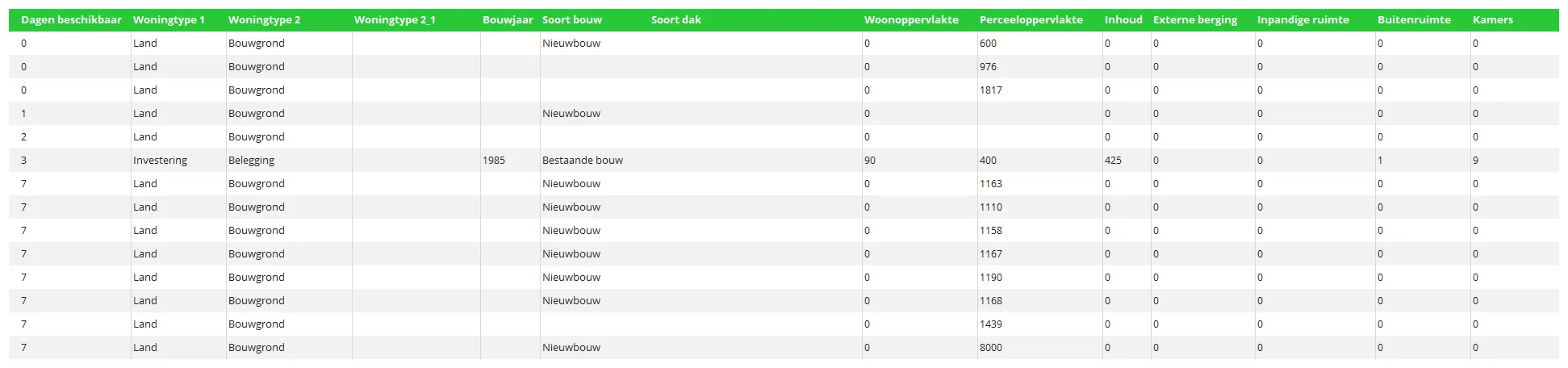
View current property developments, new-build projects, regional activity and available real estate from one central dashboard.
Practical example: from individual properties to market insight
Many organisations monitor only a limited part of the real estate market.
They occasionally check a property platform, keep an eye on a few projects or receive a periodic market report.
This provides no more than a snapshot.
Collecting real estate information daily provides insight into developments such as:
- which new-build projects are being launched
- which regions are growing
- where new business parks are being developed
- which shopping districts are evolving
- how supply is developing by region
- where commercial opportunities are emerging
The question therefore changes from:
Which properties are for sale today?
to:
Which developments are changing the real estate market, and where are new opportunities emerging?
This is precisely what makes real estate market intelligence a strategic tool for investors, property developers, municipalities, estate agents and real estate organisations.
What are the benefits of real estate market intelligence?
Automatically collecting, combining and continuously updating real estate information creates a more reliable and complete view of the real estate market.
Organisations use real estate market intelligence for:
- market research
- location research
- property development
- competitor analysis
- expansion research
- investment analyses
- area development
For many organisations, this results in:
- earlier insight into market developments
- less manual research
- faster identification of opportunities
- better-informed investment decisions
- better insight into new-build and area developments
- a more complete and current view of the real estate market
Which organisations can benefit from real estate market intelligence?
Property developers
Track new-build projects, housing supply and area developments to identify market changes and future development opportunities sooner.
Investors
Analyse property supply, new-build developments, regional growth and market activity to support investment decisions.
Municipalities
Monitor new-build projects, residential construction, business parks and other area developments to gain better insight into changes within cities and regions.
Real estate advisers
Combine current property and location data to support clients with market analyses, location research and insight into real estate developments.
Retail and expansion teams
Map shopping districts, business parks, urban developments and commercial locations to identify promising areas for new locations and expansion.
Combine real estate market intelligence with other solutions
Data Matching
Link properties, locations and company information from different data sources into one reliable overview.
Dashboarding
Visualise property developments, regional trends and project information in interactive dashboards.
MCP AI Data Integration
Make current real estate data directly available to AI applications, analyses and internal business processes.
Business Risk Monitoring
Combine real estate information with developments concerning companies, suppliers and business relationships for a more complete view of the market.
From real estate data to real estate intelligence
Almost every organisation has access to real estate information.
The difference is made by organisations that do not simply record developments, but also understand what they mean for their market.
Combining data on property supply, new-build projects, location developments and market activity creates Real Estate Intelligence.
This turns real estate data into more than a collection of properties.
It becomes a strategic source of information that helps organisations identify growth areas, recognise investment opportunities sooner and make better-informed location and market decisions.
Frequently asked questions
What is real estate market intelligence?
Real estate market intelligence is the automated collection and analysis of public data about the property market. This includes housing supply, commercial real estate, new-build projects, location developments and market activity. It provides an up-to-date picture of how the real estate market is developing.
Why is up-to-date real estate information important?
The real estate market changes every day. New projects are announced, properties become available, locations develop and regions grow. By continuously tracking these developments, organisations can respond to new opportunities sooner and make better-informed strategic decisions.
What real estate data can Scrape IT collect?
Depending on the application, we collect data on homes for sale, rental properties, commercial real estate, business premises, new-build projects, locations, availability and market activity.
Can I automatically monitor new-build projects?
Yes. Scrape IT can automatically identify new residential, commercial and area development projects. This gives you early insight into projects relevant to investment, acquisition or market research.
Can I track developments by region?
Yes. Market information can be filtered by province, municipality, town or city, postcode area and specific regions. This makes regional differences and growth areas immediately visible.
Which organisations can benefit from real estate market intelligence?
This solution is used by property developers, real estate investors, municipalities, estate agents, real estate advisers, retailers and expansion teams, among others.
How often is the real estate data updated?
This depends on the data source and your requirements. For many applications, data is updated daily so that you always have access to current market information.
How is the data delivered?
Real estate data can be delivered via API, dashboards, CSV, Excel, JSON, XML, Parquet, Power BI, MCP, EDI, (S)FTP, email alerts or a direct integration with your own systems. Almost any preferred form of data delivery or integration is possible.
Can historical real estate data be stored?
Yes. Historical data makes it possible to analyse developments over longer periods, such as changes in supply, new-build activity, market activity and regional growth.